
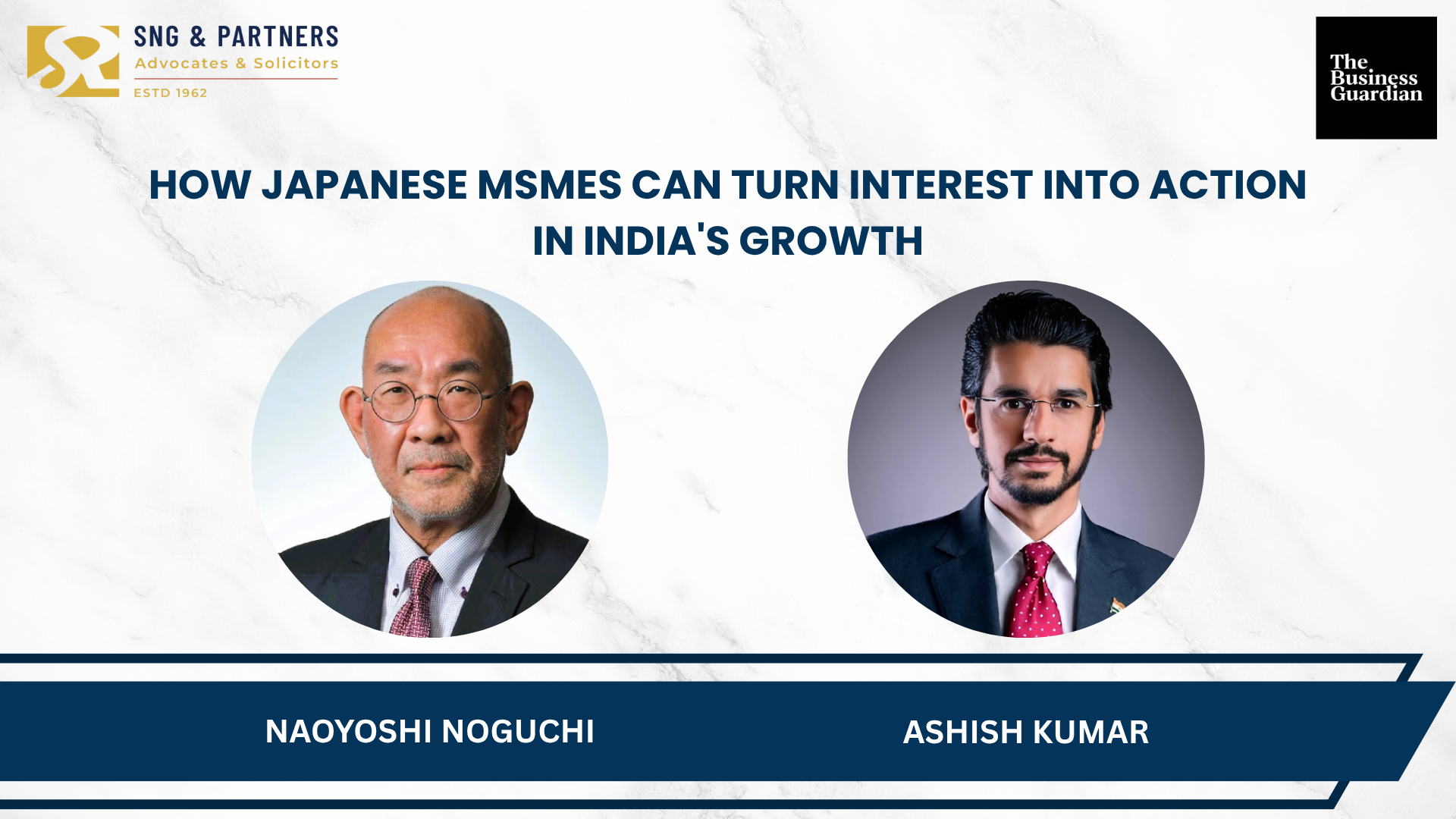

Bridging the Gap – The paradox of interest vs. action
Naoyoshi Noguchi & Ashish Kumar
In recent years, the economic corridors between India and Japan have hummed with unprecedented dialogue. Government initiatives, bilateral summits, and institutional frameworks have laid the foundations for macroeconomic cooperation. For Japan’s Micro, Small, and Medium Enterprises (MSMEs), India is no longer a distant market.
Bureau offices like the Japan External Trade Organization (JETRO) and various prefectural trade bodies report a historic high in routine inquiries from Japanese entrepreneurs. They ask about Indian demographics, regulatory frameworks, and market potential.
Yet, a persistent paradox remains: the wave of curiosity has not yet translated into a proportionate number of Japanese MSMEs establishing physical offices, factories, or joint ventures in India.
While large Japanese conglomerates, including automotive and electronics giants and major trading houses (Sogo Shosha), have the financial capability and risk appetite to navigate overseas expansion, MSMEs operate on tighter margins and shorter timelines. For a Japanese small business, relocating capital and talent is a high-stakes decision. The hesitation often stems from perceived complexities in local compliance, cultural nuances in business negotiation, and an inability to visualize where their niche expertise fits within India’s massive scale.
However, hesitating at the doorstep means missing out on the defining growth story of the 21st century. India is undergoing a profound structural transformation. By shifting the lens from “risk mitigation” to “strategic opportunity,” Japanese MSMEs can unlock unparalleled growth.
The Demographic Dividend and the Evolution of Indian Demand
For decades, foreign companies viewed India primarily as a cost-effective back-office outsourcing hub or a source of inexpensive labour. Today, that narrative is obsolete. India is now the world’s most populous nation, but more importantly, it possesses one of the youngest demographic profiles globally, with a median age under 30.
This demographic dividend is driving a massive, consumption-led economy through the rapid expansion of the neo-middle class and increasing disposable income.
From Frugal Consumption to Value Consumption
The Indian consumer’s mindset has shifted dramatically. There is now strong demand for quality, reliability, and longevity, traits that are inherently embedded in the DNA of Japanese manufacturing (Monozukuri).
As household incomes rise, there is increasing appetite for products that improve quality of life, such as advanced home appliances, automation solutions, health and wellness products, and specialized agricultural technologies.
Indian domestic manufacturers scaling up to meet this consumer demand urgently require high-precision components, specialized moulds, advanced die-casting capabilities, and efficient factory automation tools, creating significant B2B opportunities.
This is precisely where Japanese MSMEs excel. Japanese small businesses often hold global monopolies in highly specific niche components or specialized chemical processes. By establishing a local presence in India, they are not merely entering a new market. They are positioning themselves at the epicentre of a consumer revolution that demands the very precision they have spent decades perfecting.
Harmonizing with ‘Make in India’ and Supply Chain Resilience
The Government of India’s flagship Make in India initiative, supplemented by the Production Linked Incentive (PLI) schemes, has fundamentally altered the manufacturing landscape. The policy environment is heavily geared toward transforming India into a global manufacturing and export hub, reducing import dependencies, and building resilient supply chains.
The Anchor-Client Ecosystem
For a Japanese MSME, the prospect of entering India alone can seem intimidating. However, the most viable path often lies in following or partnering with the “anchor clients” — the large Japanese and global OEMs (Original Equipment Manufacturers) already entrenched in India.
As major automotive and electronics corporations expand their Indian factories under the Make in India initiative, they face strict mandates and economic pressures to localize their supply chains. They require high-quality local suppliers capable of maintaining global standards without relying on expensive and time-consuming imports.
A Japanese MSME that establishes a local workshop or engineering office in industrial corridors such as Neemrana, Manesar, Mandal, or Sri City instantly becomes an invaluable asset to these larger anchor companies. The market is already validated, and the buyer is often a familiar entity.
New Frontiers: EV, Data Centres and Renewable Energy
While traditional sectors such as automobile components and heavy machinery remain robust, the modern Indian economy is rapidly expanding into new frontiers. With the Government of India’s strong focus on climate goals, digitalization, and green energy transitions, these emerging sectors offer a level playing field where agile MSMEs can outperform slower-moving conglomerates.
Electric Vehicles (EV) and Mobility
India’s EV transition is happening at breakneck speed, particularly in public transport and the two-wheeler segments. The market demands localized innovation in battery management systems (BMS), thermal management, lightweight materials, and efficient charging and service infrastructure.
Japanese MSMEs with expertise in electronic circuitry, specialized sensors, and advanced metallurgy can find immediate joint venture partners in India eager to leapfrog legacy technologies.
Data Centres and Digital Infrastructure
With the world’s highest mobile data consumption per capita and a massive push toward cloud computing and artificial intelligence, India is experiencing a data centre construction boom. Already, many large players in this sector have begun committing significant resources to meet this growing demand.
Data centres require highly reliable, continuously operational environments. Japanese small and medium enterprises specializing in precision cooling systems, vibration-isolation technologies (essential for seismic security), energy-efficient power distribution units, and advanced industrial cybersecurity solutions are uniquely positioned to capture this market.
Renewable Energy and Green Hydrogen
India is rapidly moving toward non-fossil fuel energy capacity. The nation is investing heavily in solar infrastructure and wind energy and aims to become a global hub for green hydrogen production.
This transition requires sophisticated engineering solutions, including high-durability coatings for solar panels operating in harsh environments, precision seals and valves for hydrogen transport, smart grid management software, and IoT-based monitoring devices.
The key question, however, is this: if the opportunities are so vast, why does the bottleneck persist?
For many Japanese MSMEs, the primary obstacle is not financial or structural, but human. The linguistic barrier, cultural differences, finding a trustworthy local manager or business partner who understands both the Indian business ecosystem and the core values of the Japanese parent company, and the challenge of managing a workforce thousands of miles away often delay decision-making.
To turn inquiries into ground reality, Japanese entrepreneurs must move away from traditional corporate expansion methods and adopt a leaner, more agile methodology tailored to their actual resource constraints. Automation, artificial intelligence, and other technological tools can assist significantly in this transition.
Additionally, while recruiting high-calibre talent in India may be an expensive proposition for a small business, an effective yet underutilized alternative lies in hiring from the Indian diaspora already residing in Japan. Such individuals possess first-hand experience of both societies, languages, and work cultures, enabling them to naturally align with the company’s philosophy while implementing it effectively in India.
Leveraging Dedicated Infrastructure
Historically, organizations like JETRO provided physical Business Support Centres to help small firms establish themselves in foreign markets such as India. While this specific facility is no longer available, the infrastructure ecosystem for entering India has evolved into something far more robust.
Many state governments are now earmarking special industrial zones catering specifically to Japanese businesses. Rather than attempting to navigate bureaucratic hurdles and build facilities from scratch, Japanese MSMEs should utilize the network of Japanese Industrial Townships (JITs) spread across major Indian industrial corridors, or leverage modern private co-working spaces.
These townships offer a plug-and-play environment featuring ready-made rental factories, dedicated power grids, pre-cleared zoning approvals, and single-window administrative clearances. This environment closely replicates the reliability of a Japanese industrial zone, allowing visiting Japanese staff on short-term assignments to operate seamlessly and comfortably.
Effective Legal Framework for Business
Another significant concern for Japanese companies is often the perceived complexity of Indian laws and the time traditionally associated with resolving legal disputes. As a matter of business culture, Japanese companies generally prefer to avoid litigation and place greater emphasis on maintaining long-term business relationships.
With the push for Make in India, however, India’s legal and regulatory landscape has undergone significant transformation over the last decade, with a clear focus on enhancing the ease of doing business, attracting domestic and foreign investment, and creating a transparent and efficient legal framework.
Recognizing that an investor-friendly environment requires both regulatory simplification and robust governance standards, the Government of India has undertaken a series of legislative and policy reforms aimed at modernizing India’s legal ecosystem.
A large number of obsolete and archaic laws have been repealed, while several overlapping legislations have been consolidated to reduce complexity and improve compliance. Efforts have focused on digitization of governance, simplification of regulatory processes, reduction of procedural bottlenecks, and promotion of transparency and accountability across sectors.
One of the most significant developments has been labour reform through the consolidation of 29 central labour legislations into four comprehensive labour codes:
- Code on Wages, 2019
- Industrial Relations Code, 2020
- Occupational Safety, Health and Working Conditions Code, 2020
- Code on Social Security, 2020
These reforms seek to balance the interests of employers and employees by simplifying compliance requirements, expanding social security coverage, promoting formalization of the workforce, and creating a more flexible and productive employment environment.
India has also taken substantial steps toward strengthening its digital economy through the enactment of the Digital Personal Data Protection Act, 2023, which provides a modern framework for the protection and processing of personal data.
The legislation seeks to align India’s data governance regime with international standards, enhance consumer confidence, and provide businesses with greater clarity regarding data management and privacy obligations in an increasingly digital world.
Another Landmark Reform: The Mediation Act, 2023
Another landmark development has been the enactment of the Mediation Act, 2023, which provides a comprehensive statutory framework for mediation in India.
The legislation institutionalises mediation as an effective dispute resolution mechanism and complements the existing requirement of pre-institution mediation in commercial disputes under the Commercial Courts Act.
The Indian judiciary is also actively advocating mediation between parties to facilitate quick and amicable resolution of disputes rather than lengthy litigation. Many entities, including government undertakings, are now legally incorporating mediation clauses into their dispute resolution mechanisms before initiating arbitration or litigation.
These measures reflect a conscious policy shift toward facilitating quicker, cost-effective, and business-friendly methods of resolving disputes, thereby reducing the burden of prolonged litigation.
Strengthening Arbitration
In addition to mediation, successive amendments to the Arbitration and Conciliation Act, 1996, together with progressive judicial pronouncements, have substantially strengthened India’s arbitration framework.
The reforms have focused on reducing judicial intervention, promoting party autonomy, ensuring time-bound completion of arbitral proceedings, facilitating enforcement of arbitral awards, and bringing Indian arbitration practices closer to internationally accepted standards.
These reforms have been accompanied by broader measures aimed at strengthening corporate governance, enhancing transparency, curbing fraud, promoting digital compliance, and creating greater regulatory certainty for businesses.
The cumulative effect of these initiatives has been the creation of a more modern, efficient, and predictable legal environment that fosters entrepreneurship, encourages investment, and supports India’s aspiration to become one of the world’s leading economic powers.
Conclusion: A Confluence of Purpose
The reluctance of Japanese MSMEs to establish a footprint in India is largely a psychological and managerial gap, not an economic one.
The macroeconomic alignment between India and Japan is stronger than ever, legal protections for intellectual property are robust, and the digital ease of doing business in India has improved exponentially.
For Japanese MSMEs, establishing an operational base in India is no longer an optional gamble in an unknown market. It is a vital strategy to ensure long-term corporate growth, tap into global talent pools, and diversify away from a shrinking domestic market.
The initial inquiries at JETRO, prefectural boards, and other agencies have successfully laid the groundwork.
The structural blueprints are ready.
By embracing a lean, trip-based management model and empowering cross-cultural talent who share their corporate philosophy, Japanese MSMEs can minimize risk, cross borders with confidence, and co-author the next triumphant chapter of Indo-Pacific economic growth while strengthening Indo-Japan bilateral relations.
Authors
Naoyoshi Noguchi
Former Executive Vice President, JETRO, and Advisor, Japan Desk, SNG & Partners.
Ashish Kumar
Partner, Head of Japan Desk & Corporate Disputes practice, SNG & Partners.